Project Description

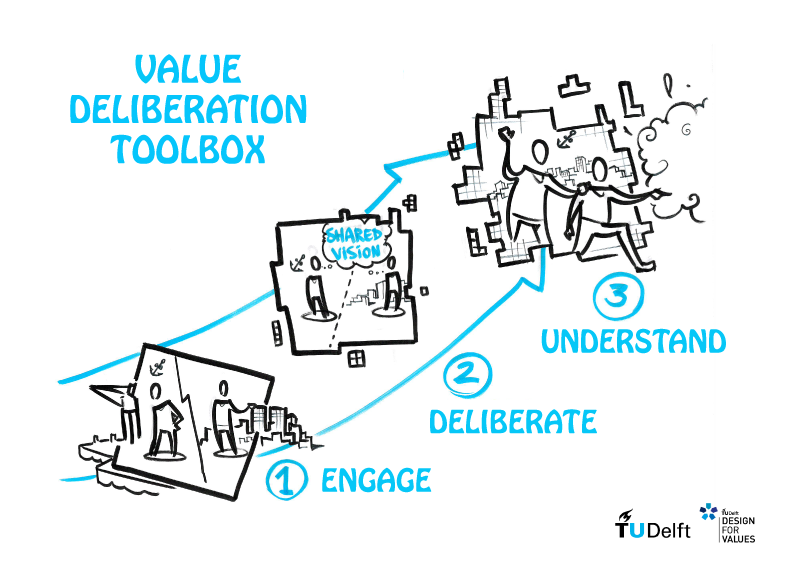
Our societies often face complex problems where there are many differing views on how to resolve them. Sometimes, different individuals or groups might even have conflicting objectives for these problems. For example, high stakes policy programs like the energy transition and large infrastructure projects involve many stakeholders with a wide gamut of perspectives. This toolbox was developed as part of a seed project funded by the DDfV Institute. It is based on a new (novel) methodology to accelerate the strategizing process by helping stakeholders understand each other’s values that they associate with different solutions to the problem.

Beyond more traditional approaches, research has shown that participants may cooperate if they understand each other’s values and why they prefer certain solutions. By discussing their values with one another, they may see more commonalities with each other or empathize for others’ concerns that they might have dismissed before. The framework allows a facilitator to guide conflicting participants towards commonly agreeable strategies by encouraging a value-based discussion between the participants.

The process works best where there are distinct strategies and participants are willing to listen to, work with, and cooperate with one another. The overall objective is for them to better understand each other and become more willing to cooperate.

Features and Roles

The Value Based Deliberation toolbox has been successfully applied to the Port-City futures conference held at TU Delft in November 2018 and some other events and summits too. Different stakeholders from academia, industry, ports, and municipalities participated in the conference to deliberate about energy transition scenarios for the port of Rotterdam.

Organizer’s Guide

Value based deliberation is a novel methodology to facilitate multi stakeholder participation that can be used when stakeholders have different ideas of what the best solution could be yet they are willing to listen to each other. This method can be used to help different stakeholders to understand each other’s perspectives on a wide range of issues. Research has shown that when stakeholders can better empathize or understand each other, they are more likely to cooperate with each other an reach a common ground. The process works best where there are distinct scenario. All the participants also need to be seen as equals and respected. The overall objective is for them to better understand each other and become more willing to cooperate.

There are few points that must be taken into account to ensure that the stakeholders are fully involved in the deliberation process.

Firstly, there must be enough participants in a group so as to ensure that the discussion is fruitful and new insights can be obtained from the discussion. Diversity among participants is also a factor here since a homogenous group might result in a one sided discussion. Therefore, depending on the problem, enough stakeholders who can actively participate in the discussion have to be invited considering that some stakeholders may not decide to attend the deliberation.

Secondly, the participants must know the purpose of deliberation process. Public policy problems often involve deadlocks between stakeholders because of disagreement between what they consider to be the best solution. Thus, Value deliberation process enables stakeholders to realize the perception of other stakeholders through a discussion on what values are considered important by the stakeholder and how are they associated with each solution. Generally if there are more than 10 people in a group, the groups are split into two so as to ensure that all the participants can effectively interact with each other as well as the facilitator can manage the facilitation process. Therefore, the participants need to informed of the group size before the value deliberation process in order for them to have an idea about the setup of the deliberation process.

Facilitators must be explained the significance of each and every step of the methodology. They must also be trained about dealing with different situations that may arise during the actual deliberation process. Apart from the facilitator’s guide that is provided to them, they must be briefed before the actual session on the topic, alternatives and general methodology and points that must be covered during the discussion.

Below are some qualities important for facilitors to have:

  1. Neutrality – Facilitator should be neutral to ensure that he/she does not pick any side during the discussion
  2. Active listening – Through paraphrasing and active listening, he/she must set tone for respectful and positive interaction and also perceive what needs to be brought in discussion if certain elements are missing
  3. Value for diversity – The diverse stakeholders must feel an integral part of the discussion and a facilitator who values diversity can create a positive environment in which all stakeholders can freely express their opinion
  4. Time management – It is important to effectively structure the perspective of different stakeholders in the limited time available and to steer the discussion towards the main topic in case it is diverging from it. This requires efficient time management on part of the facilitators

1) Diversity of participants

It is important that the group be as diverse as possible to take into account perspectives of all stakeholders in a group. However, it heterogeneity is not possible, the discussion could go on in a homogenous group as well.

2) Number of participants

Ideally, there should not be more than 10 participants in a single group since it becomes difficult for the facilitator to manage the group as the number of participants increase and also it is difficult for the participants to interact with more than 10 members.

3) Materials needed

  1. Poster (A0 or A1 size; our included PDF can be used for both)
  2. Post-its (size dependent on poster size; choose 3 colors)
  3. Pens (at least one for each participant)
  4. Sustenance (Tea, Coffee, etc)

4) Picking the space

In essence, the space needs to be picked based on the number of participants. As mentioned earlier each group would have around 10 participants so depending on the number of groups, a large hall or multiple small rooms (depending on the number of groups) need to be reserved.

Learn More

Pigmans, Klara; Dignum, Virginia, & Doorn, Neelke. (2019). “Group proximity and mutual understanding: Measuring onsite impact of a citizens’ summit”. Journal of Public Policy, 1-23. doi:10.1017/S0143814X19000230

The zip file (780kB) includes:

  • Poster – helps compile and organize participants’ arguments and values
  • Organizer’s Guide – same information as it can be found on this page, but in a printable format
  • Facilitator’s Guide – printed document for facilitators
  • Ranking calculator – Excel template for quickly calculating the overall rankings

Creators

[dvmember id="3745" gridstyle="full" offset="20" itemwidth="250" side="right" rounded=""][dvmember id="2396" gridstyle="full" offset="20" itemwidth="250" side="right" rounded=""][dvmember id="2214" gridstyle="full" offset="20" itemwidth="250" side="right" rounded=""]

Text and lay-out of the Toolbox created by Ruchik Patel and Jason Wang.